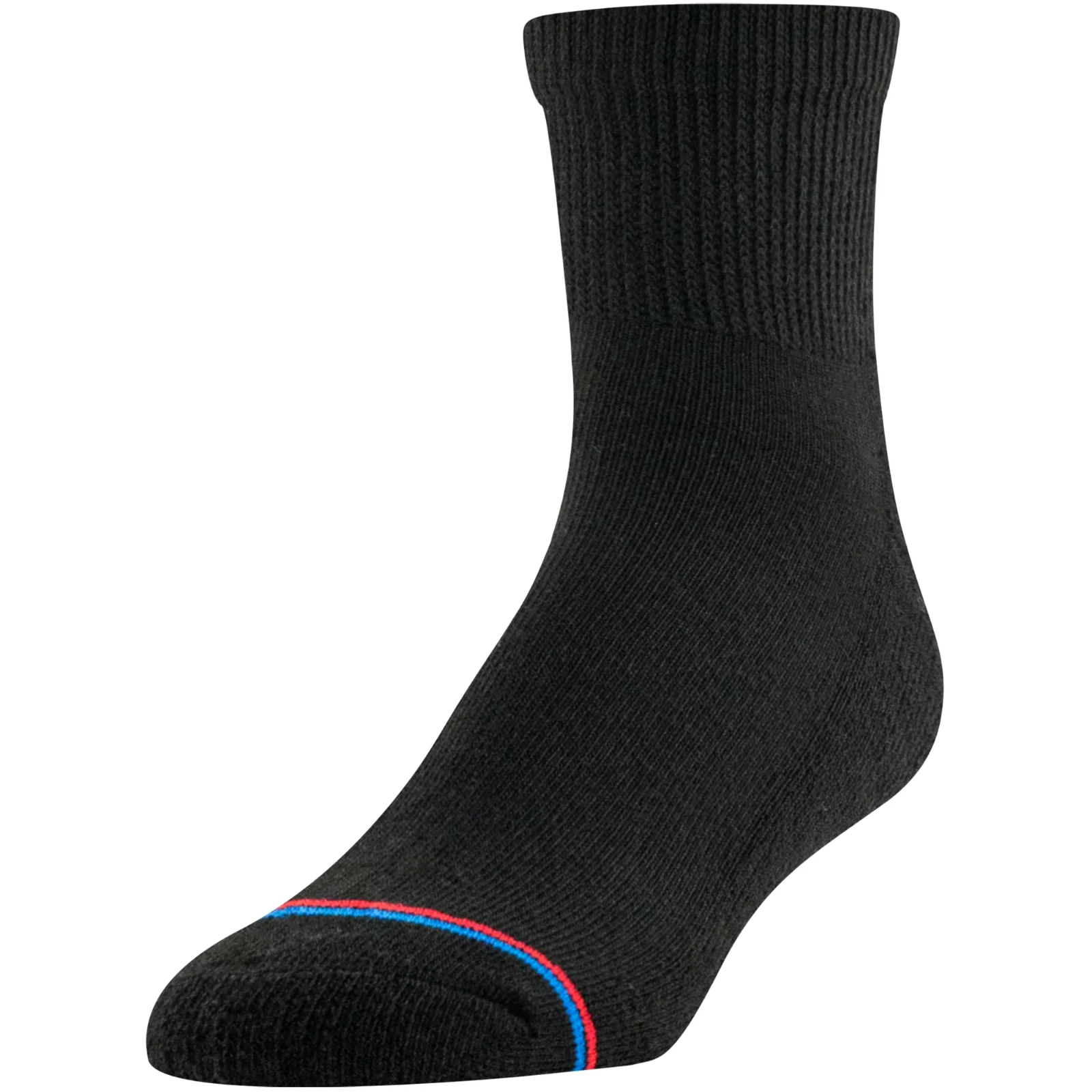
What a non-binding sock top is
The ring above your ankle at the end of a day is a rubber thread doing its job. Here is what happens when it is left out, what you gain, and the one thing you give up.
Official MediPeds catalogue
If you have taken a sock off in the evening and found a mark pressed into the skin above your ankle, that mark is a rubber thread doing its job. Every sock on these five shelves is knitted without one. Here is the whole live range, with the pack count, the shoe sizes and the price against each.
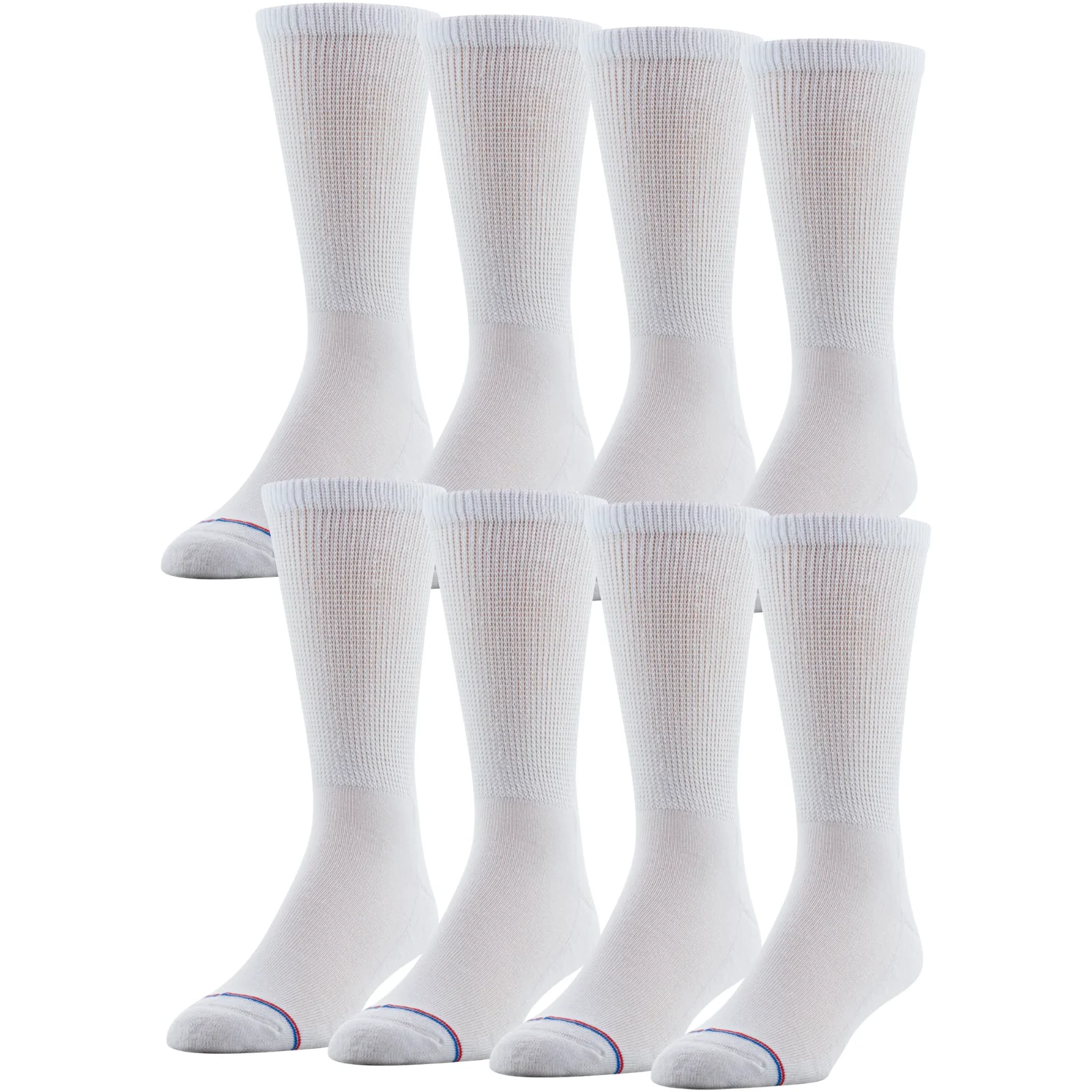
What is in the knit
None of these is a treatment. They are ways of knitting a cuff, a seam and a sole, and each of them answers a complaint people bring to a sock.
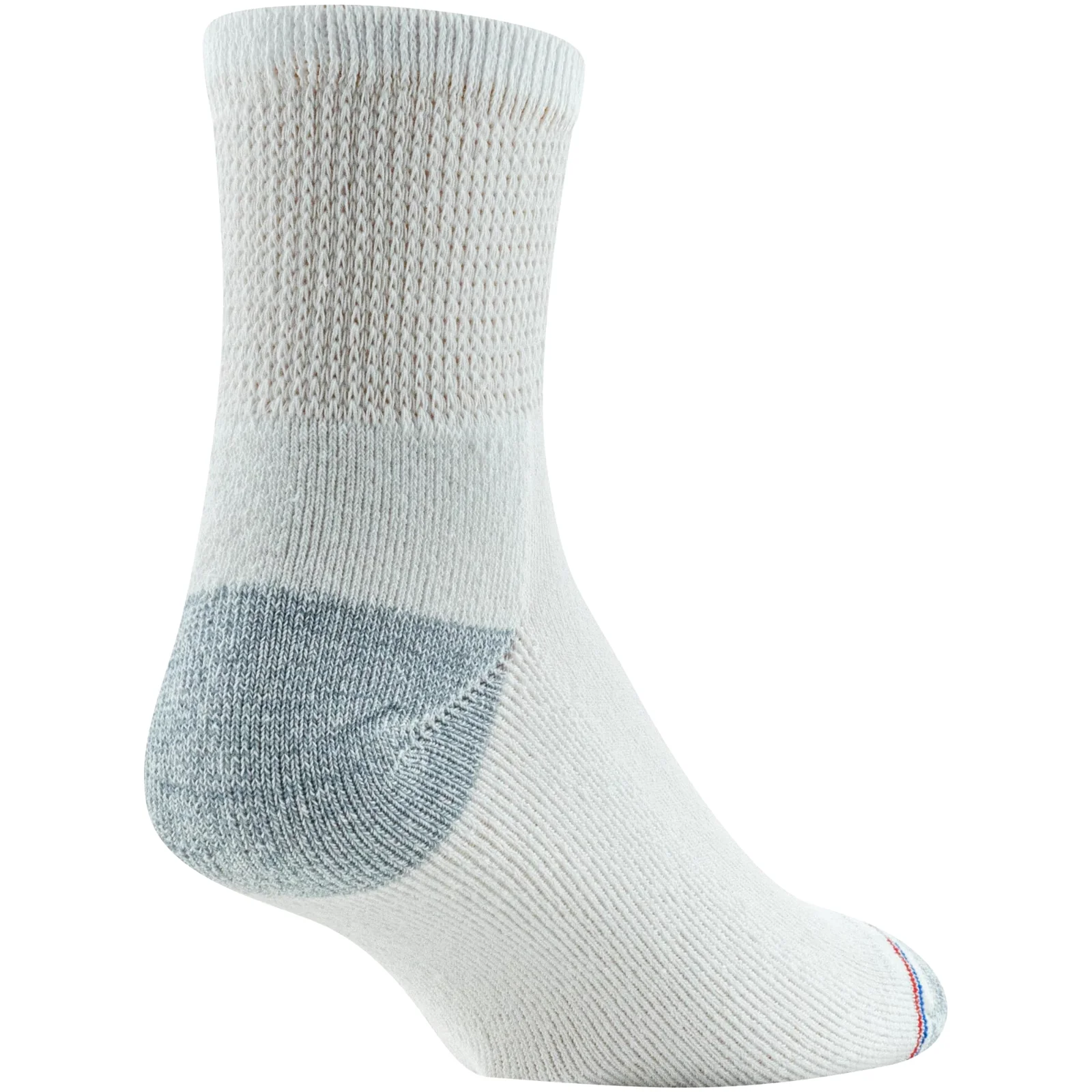
The cuff is the same yarn as the leg with extra stretch knitted into it, so it rests on the calf rather than gripping it. That is the whole of what non-binding means, and it is why the top of one of these socks leaves no ring.
The seam across the toes is knitted flat instead of being folded and stitched, so there is no ridge sitting across the top of your toes inside a shoe. It is the part of a sock people notice only when it is wrong.
Extra loops are knitted into the underfoot and around the heel. They pad the sock, and they do a second job people do not expect: they add enough friction inside a shoe to stop a cuff that does not grip from working its way down.
Most of the range is knitted to carry moisture away from the foot rather than hold it. Three lines take that further with a yarn named on the packet: Coolmax, Sorbtek and, against friction, NanoGLIDE.
Shop by what the foot needs
Height settles the first two: a crew comes up the calf, a quarter stops above the ankle bone. The third is for a leg an ordinary cuff will not go round. The fourth is the over-the-calf knit in a mild compression. The fifth is the lines chosen for their yarn rather than their height.
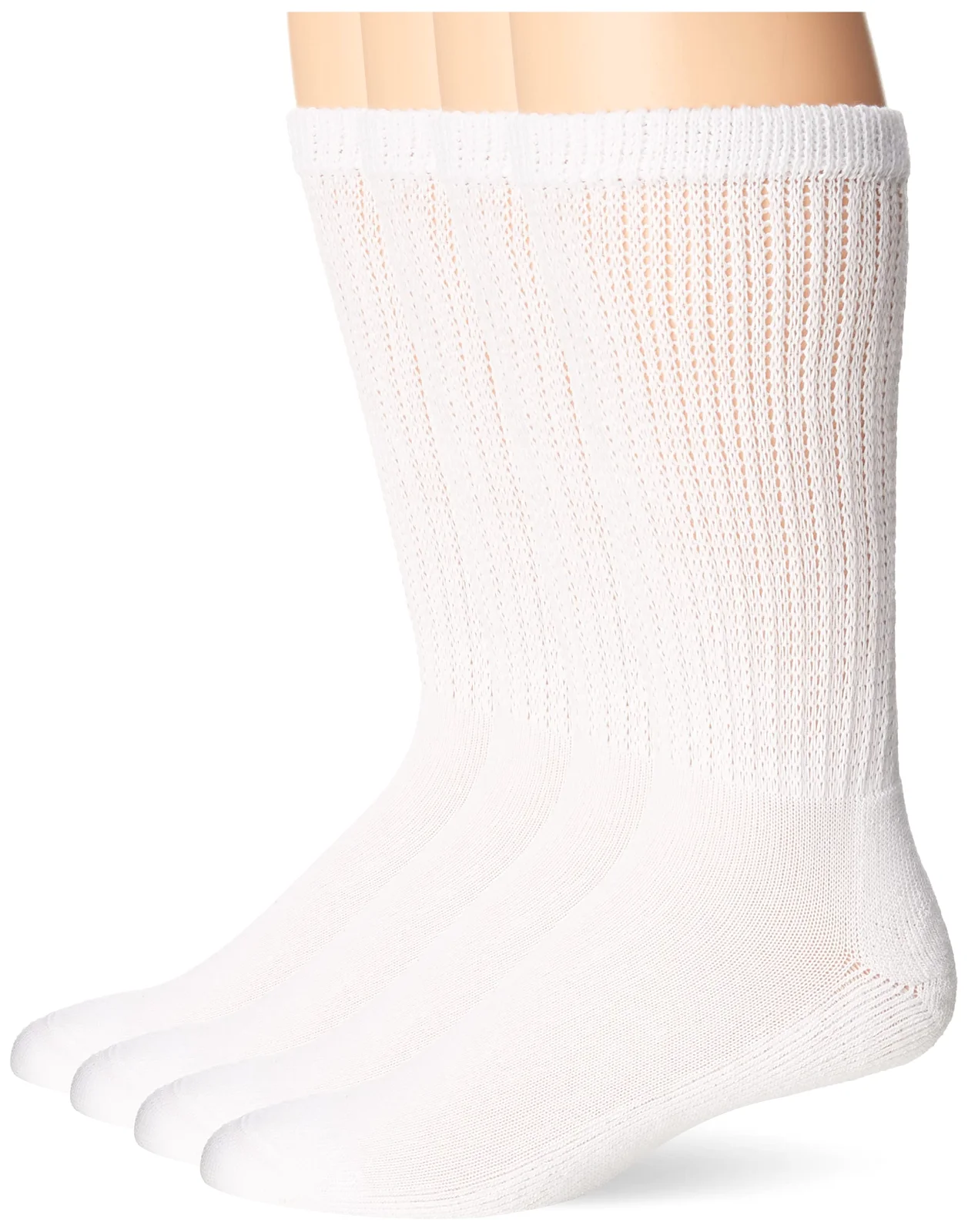 Non-binding crew socks
The shelf most people arrive on
4 socks · 4 or 6 or 8 pairs a pack
from $9.99
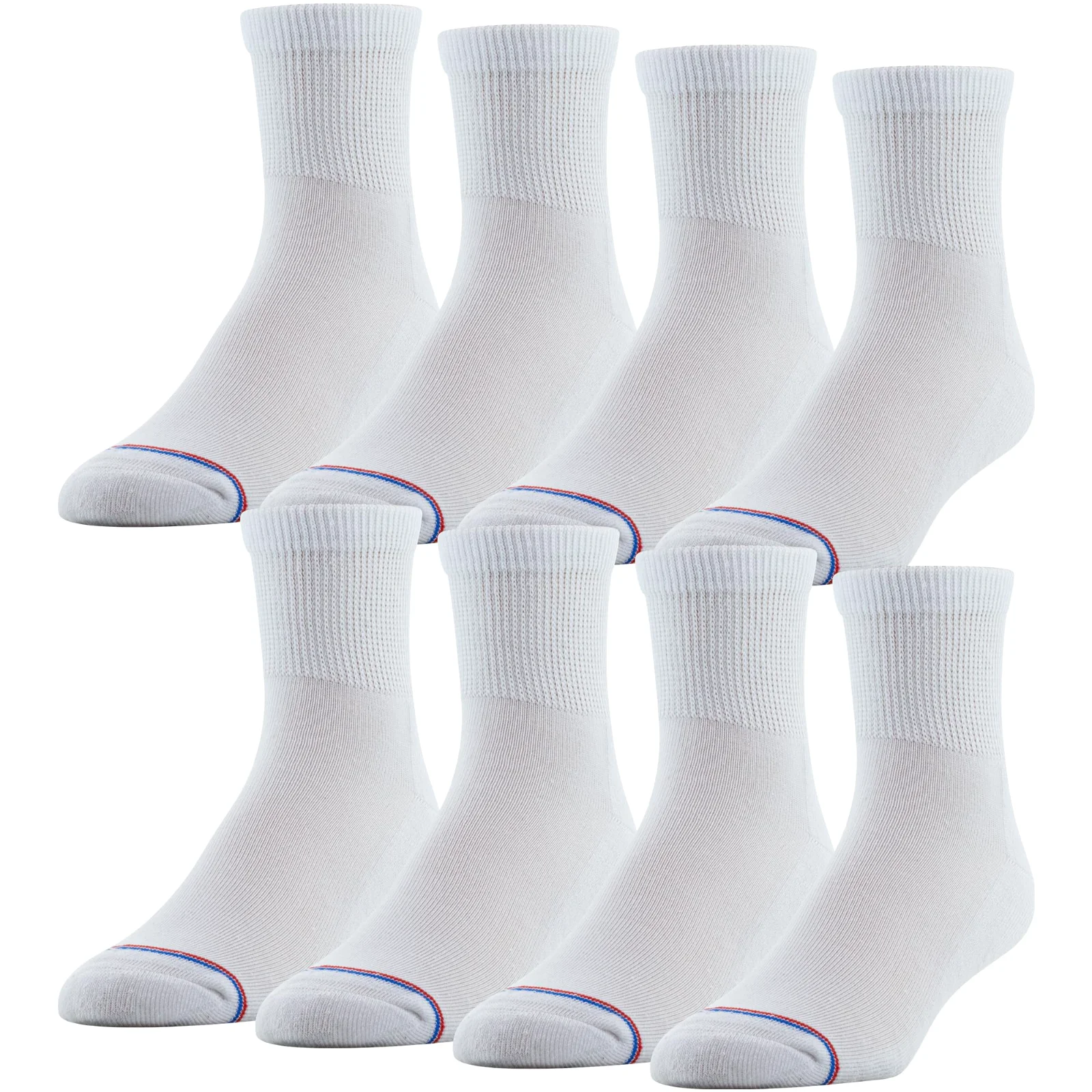 Non-binding quarter socks
Above the ankle bone, and no further
3 socks · 2 or 4 or 8 pairs a pack
from $9.99
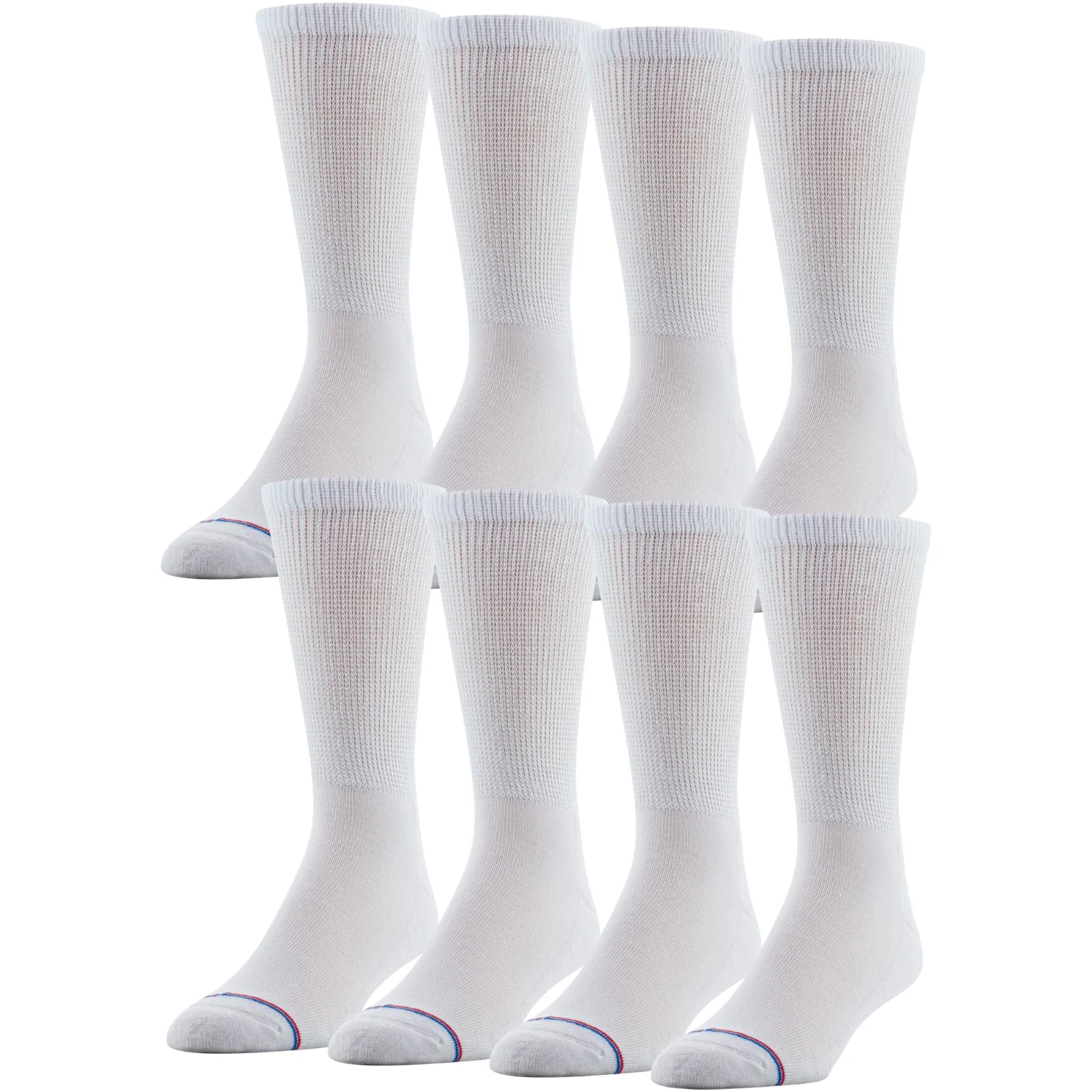 Extra wide socks
When the ordinary cuff will not go on
2 socks · 2 or 4 or 8 pairs a pack
from $9.99
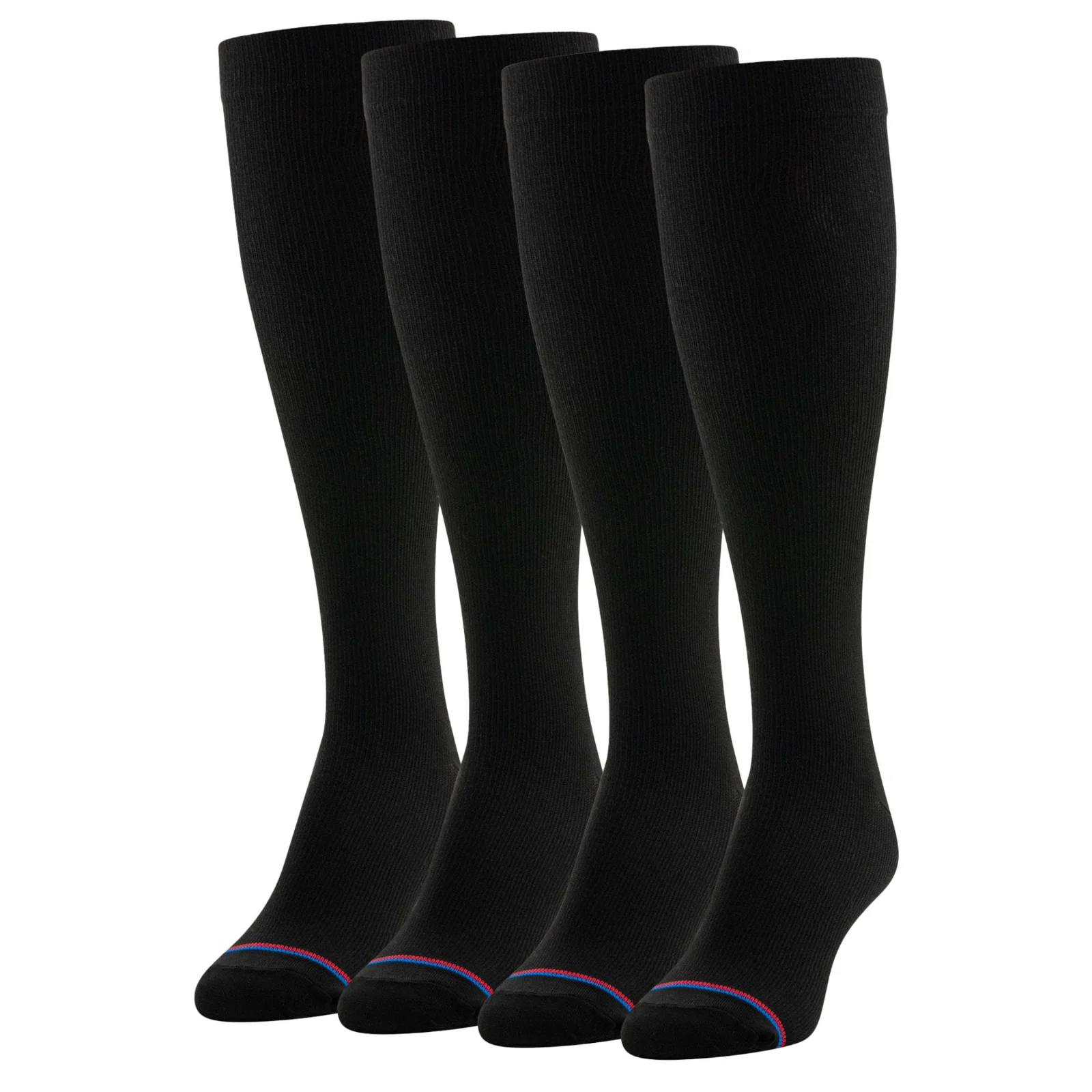 Mild compression socks
Over the calf, and mild
3 socks · 2 or 4 pairs a pack
from $9.99
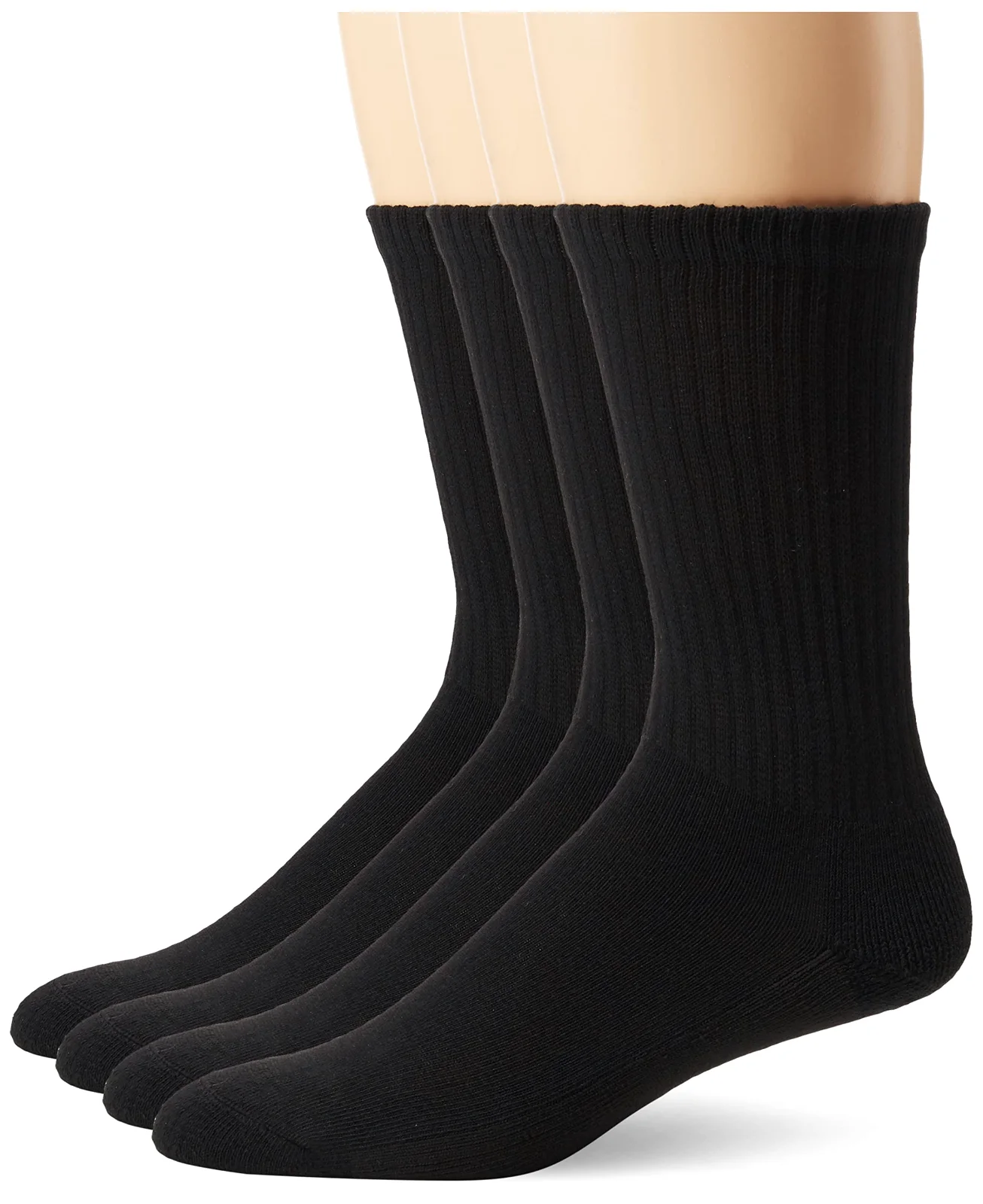 Cushioned and cooling socks
The named yarns
5 socks · 3 or 4 pairs a pack
from $7.99
Where the sock stops
Height is the first thing to settle, and it is the thing most easily got wrong from a photograph. Here are the four this catalogue is cut in, on one leg, with the shelf each belongs to.
The drawing is to scale against each other, not against your leg: where a sock lands depends on how tall you are more than on which packet you open.
All four heights are knitted by the makers at MediPeds to the same three rules: no rubber thread in the top, a flat seam across the toes, and loops under the foot.
What people take first
Ordered by how many people have rated them, not by what pays. Every card shows the pack count, what is in the knit and the price from our last update.
Non-binding crew sock
4.5 · 10,423 ratings
from $9.99
Non-binding quarter sock
4.5 · 6,948 ratings
from $9.99
Extra wide crew sock
4.5 · 4,870 ratings
from $15.50
Over-the-calf compression sock
4.5 · 2,789 ratings
from $14.49
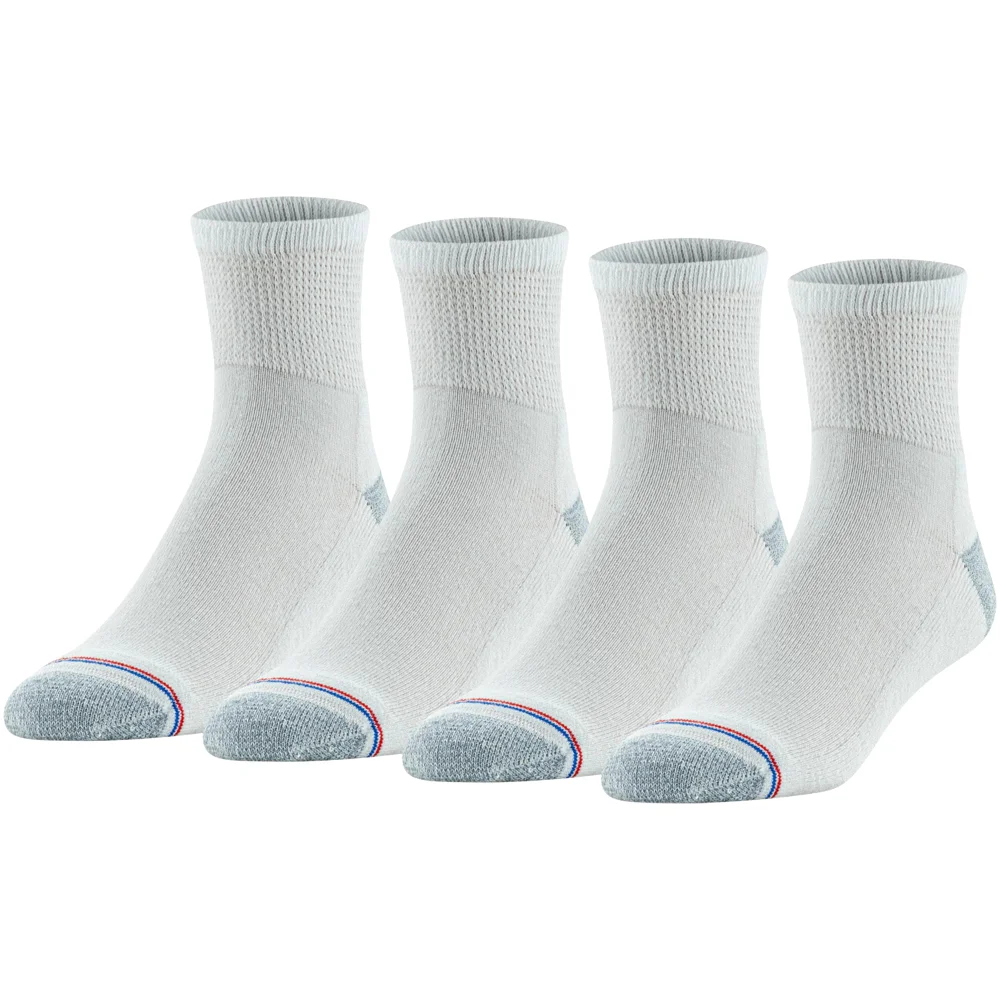
Non-binding quarter sock
4.5 · 4,807 ratings
from $10.01
Non-binding crew sock
4.5 · 2,214 ratings
from $18.35
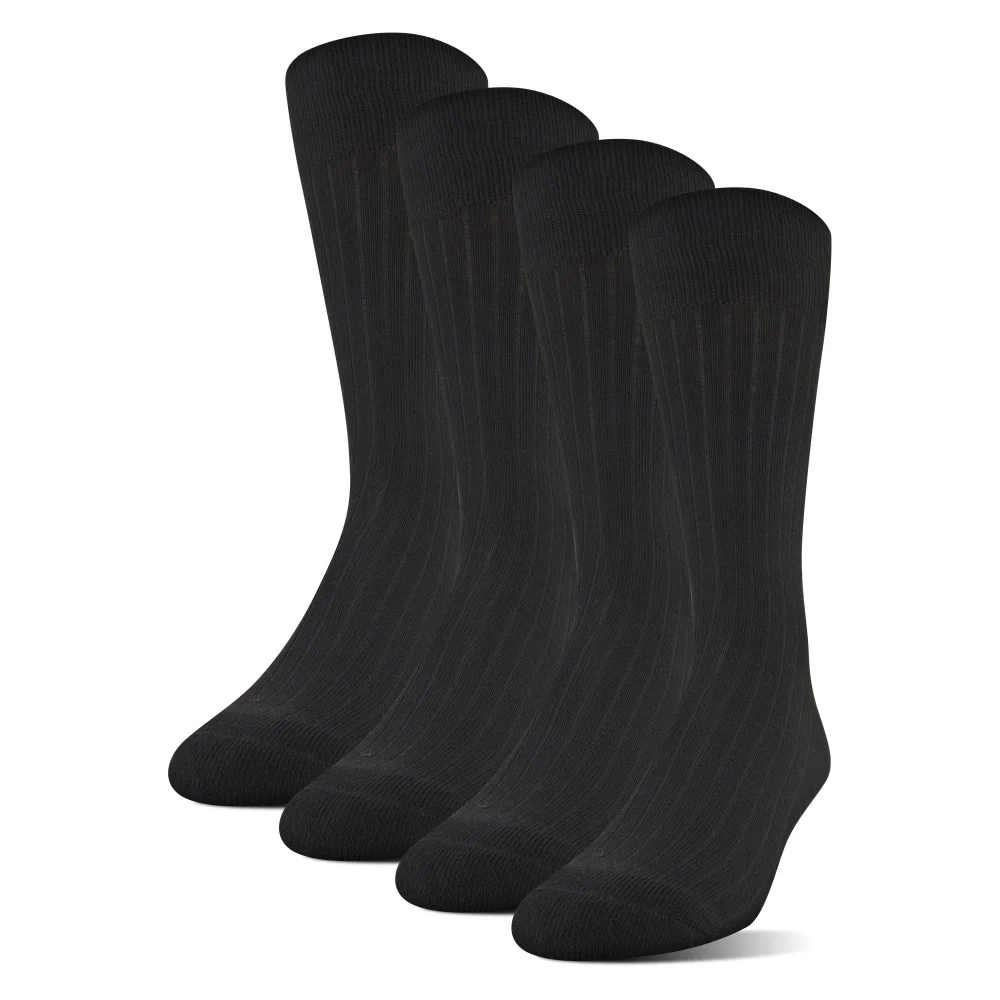
Sorbtek dress crew sock
4.4 · 294 ratings
$8.97
Memory cushion crew sock
4.3 · 219 ratings
from $7.99
Eight of 17 socks in the MediPeds shelves. The rest sit on the five shelves above, and every figure here is the one from our last update of the catalogue.
Straight to a pack
The crew and the quarter, the wide top, the compression, the eight-pair packets and the named yarns. Each page holds its own socks, its own shoe sizes and its own prices.
The word on the packet is diabetic, and what is actually different about the sock is three things you can see: a cuff knitted with no rubber thread in it, a toe seam laid flat instead of folded, and a sole padded with extra loops. This page collects every sock in the range built that way, at both heights and in the wide top, because the search that brings most people here does not know yet whether it wants a crew or a quarter.
A crew sock is the one that goes under a trouser and inside a boot, and it is where most of this catalogue sits. The page collects every crew in the range at once, which is the quickest way to see how much thickness varies inside one height: the thin Sorbtek dress crew and the memory cushion crew are the same height and nothing like the same sock, and which one you want is decided by the shoe rather than by the foot.
A quarter sock stops about two fingers above the ankle bone. That is the height people move to when a crew is too much sock for the month but a no-show leaves the back of a shoe against bare skin. Everything on this page is the same cuff and the same padded sole as the crew, cut shorter — including the NanoGLIDE quarter, which is the one to look at if a low shoe rubs.
There is a specific morning behind this page: the sock goes on over the toes and then stops. That is not a shoe-size problem, and ordering a larger size makes a longer sock rather than a wider one. These are knitted on a wider last with more yarn round the cuff, so a calf that stretches an ordinary non-binding top to its limit takes this one without the edge digging in.
These are the firmest knit in the catalogue and the tallest: over the calf, finishing under the knee, in black. They are an everyday sock bought because a leg feels heavy by the evening or a long flight is coming. They are not a stocking measured to a leg and followed up by anyone, and this page says so before it says anything else.
Getting the size right
A packet of eight is the cheapest way to buy socks and the most expensive way to get them wrong. Five minutes now saves a drawer of socks that never come out of it.
Every size here is a shoe-size range, not a foot length. Take the size you actually wear in the shoe these socks will live in, and if you wear a half size, work from the whole size above it.
If your trouble is a sock that will not come past the calf, that is width, and a bigger shoe size gives you length instead. Go to the extra wide shelf.
A boot collar sits exactly where a quarter sock stops. In a boot, take the crew. In a loafer with nothing showing, take the liner.
A cushioned sock takes up room. In a shoe that already fits closely you will feel it as half a size, and the thin Sorbtek dress crew is the one to reach for instead.
The four-pair packets exist for this. Wear a pair for a week, look at the ankle in the evening, then order the eight.
Most of this range is white or black, and the two-tone versions carry grey where the cushion is. If the sock has to disappear under a dark trouser, the white one will not.
In their own words
Comments about these socks, shown as they were written and trimmed only for length. The complaints are here too, because a wall of five stars tells you nothing about whether a sock will stay up on your leg.
★★★★★
Not TOO tight......snug without squeezing your legs and leaving marks
★★★★★
The socks arrived on time. My son seems to like them. (He has big calves, so we have to buy the diabetic socks to fit his legs.) I cannot attest to feel while wearing them, but they are soft and look comfortable. I just need to see if they can hold up to the wear and tear my son puts on his clothing.
★★★☆☆
These are nice socks but they run very small. I bought them for a man, but they were way too tight. I wear a size 8 women and they fit me perfectly. I really like them! But if you are a man or have swollen feet at all, you will have trouble with these. If you are 8W these are your socks right here!
★★☆☆☆
Not substantial enough to stay up on the legs/calfs, VERY light weight. Sorry I bought them. I won't return them, I'll use them ONLY when my GOOD ones are in the wash.
★★★★★
I have used these mild compression socks for more than 10 years. The only complaint I have is that they could use some reinforcement in the heels, as holes develop eventually in the bottom of the heels.
★★★★★
These socks fit great without being too tight! Just right! This my second pair!
★★☆☆☆
Too tight for this 158 pound female. Gave away.
★☆☆☆☆
I ordered x large socks for my husband, but the socks I received would barely fit me! They are small in length, and small in diameter, leaving marks on the skin of the leg. I've had other styles of Medipeds and have been happy with them, but whether these were wrongly marked, or the socks actually are small, I have no idea. All I can say is I wasted my money.
★★★★★
My husband likes these socks. He is a diabetic and they aren't too tight on his legs.
Who we are
The short version. The longer one, with the whole range set out shelf by shelf, is on the about page.
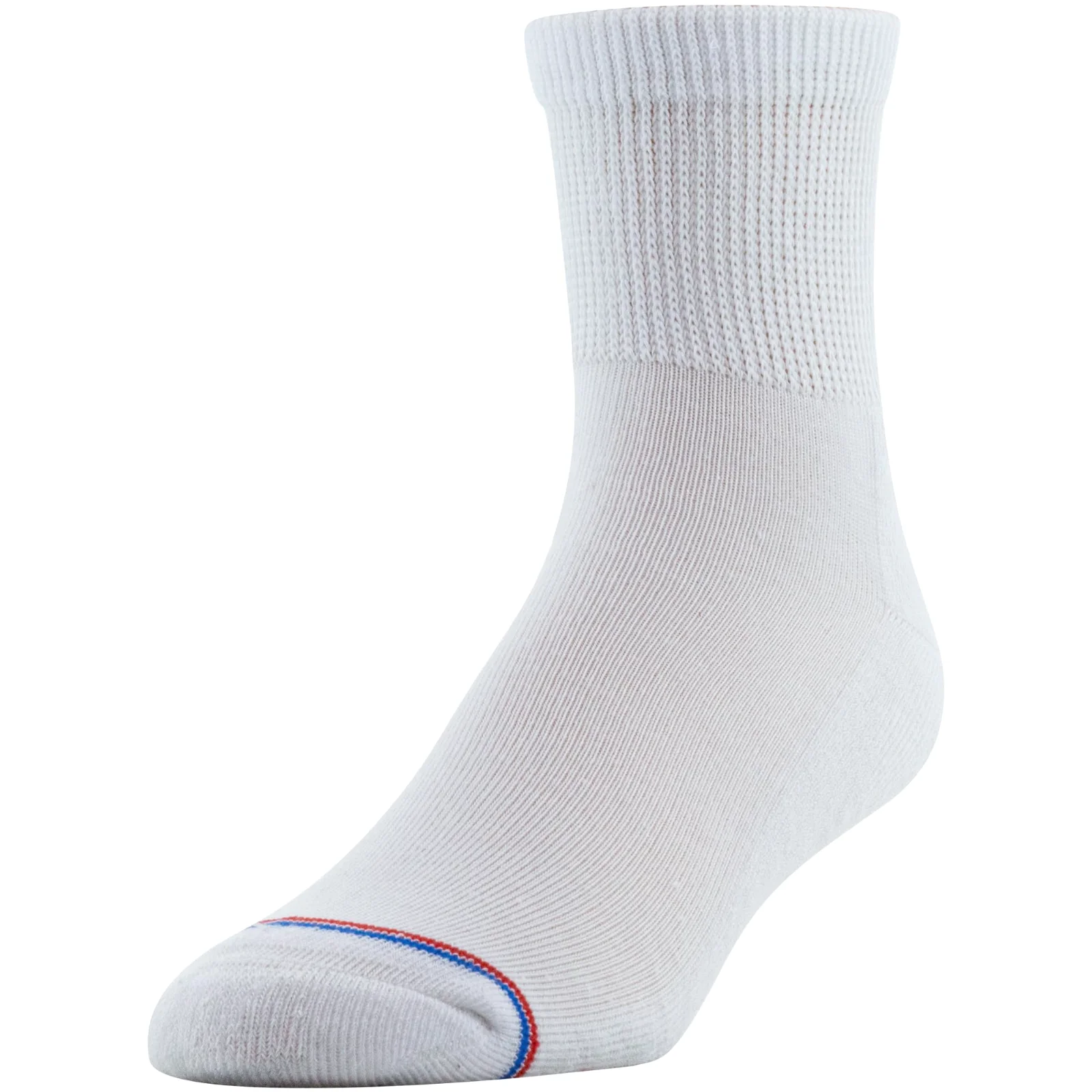
We make socks for feet that have a reason to be careful. That is a narrower job than making socks, and it explains why the range looks small next to a fashion label: five shelves, a handful of knits, and the same cuff running through nearly all of them.
What we changed, we changed once and kept. The rubber thread came out of the top. The toe seam was flattened. The sole was padded and the padding was left thick enough to feel. Everything since has been a matter of which yarn goes into the leg and how far up the leg it goes.
Fit without pressing, sit without rubbing, and stay where it was put. That is the whole of it, and it is enough to be worth getting right. Anything beyond that is a question for a clinician rather than for a catalogue.
The longer answer to what this brand is lives on Read what MediPeds makes and who it is for.
Before you order
What a non-binding top is and what it is not, how to read a shoe-size range, why a sock blisters a heel, and what to look at on a foot at the end of a day.
The ring above your ankle at the end of a day is a rubber thread doing its job. Here is what happens when it is left out, what you gain, and the one thing you give up.
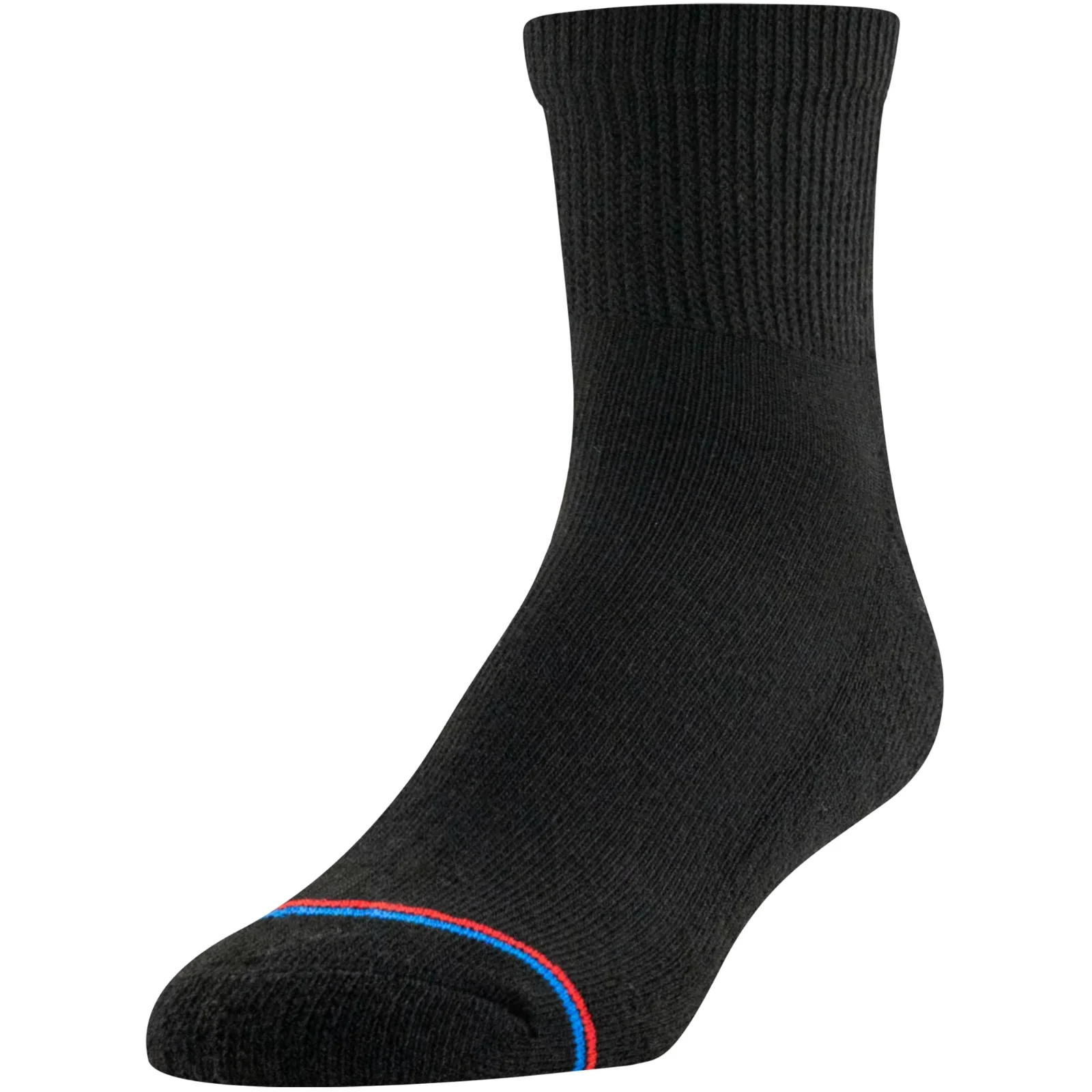
Men 7-12 with women 10-13 is one packet and two feet. What that range measures, why it is so wide, and which way to go when you sit between two.
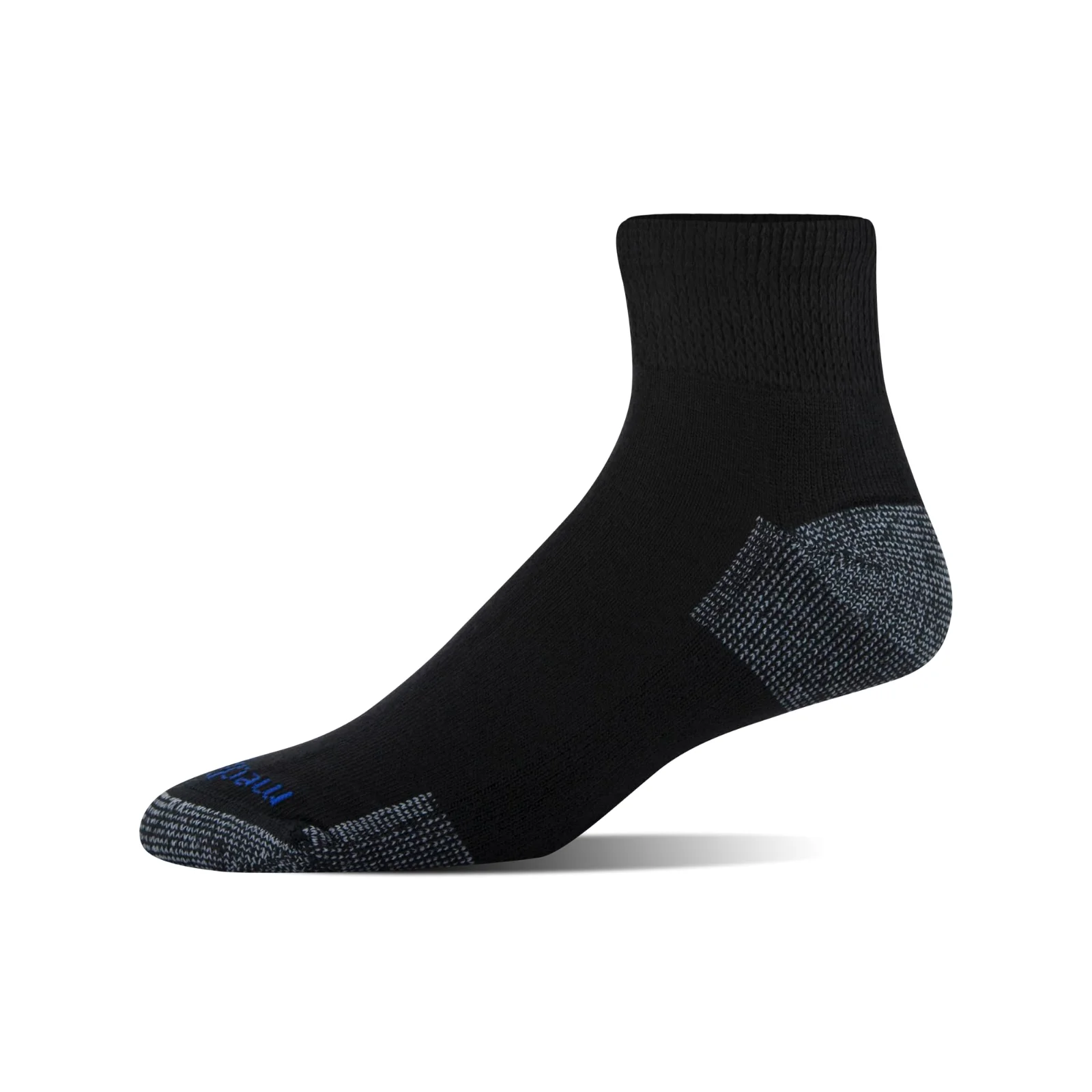
A blister is friction with nowhere to go. What is rubbing, why the same boot does it every week, and where a yarn helps and where it cannot.
Taking a sock off is the moment the check happens anyway. What the national health bodies say to look for, why the mark above the ankle is worth noticing, and where a catalogue stops and a clinic starts.
Questions people ask
Six of them. Longer answers live on the shelf pages and in the foot-care notes.
Every buying button on this site opens the packet you were looking at, in the colour and pack count you chose, at our retail partner. That is where the payment and the delivery happen, and where the price you see is the price you pay.
The button at the foot of every page opens the whole range at once, which is quicker if you are still deciding between the crew and the quarter.
Usually, and the cushioned sole is the reason. A cuff with no rubber thread in it cannot grip, so what holds these socks in place is friction under the foot: the padded loops press against the inside of a shoe and stop the foot end travelling, which is what starts a sock sliding.
On a smooth calf, in a loose shoe, or with the extra wide top, a sock can still work its way down. If that is your experience of non-binding socks generally, take the cushioned version rather than a plain knit, and take the crew rather than the quarter.
Every size here is a shoe-size range rather than a foot measurement, and the ranges are wide: men 7-12 with women 10-13 is one packet. If you sit at the top of one range and the bottom of the next, take the larger, because a sock that is slightly long folds at the toe while a short one pulls the heel pocket forward under your arch.
If the trouble is that the cuff will not go over your calf, size is not what you are looking for at all. That is width, and it is the extra wide shelf.
Both, and they are the same sock cut at two heights. A crew comes up the calf, which is what you want under a trouser and inside a boot. A quarter stops about two fingers above the ankle bone, high enough to keep a shoe collar off the skin and low enough to disappear in summer.
There are two more heights in the range: an over-the-calf sock on the compression shelf that comes up under the knee, and a sport-cut liner that finishes below the shoe line.
Four or eight on most of the range, two or four on the compression shelf, and three on the Coolmax and liner lines. The eight-pair packets are the cheaper way to buy by some margin, and every card here shows both the pack price and what is in the packet so you can do that arithmetic yourself.
If you have not worn this cuff before, take a four first. A drawer of eight socks that slide is an expensive way to learn something a week would have told you.
No, and we will not write that they are. A non-binding top and a smooth toe seam are ways of knitting a cuff and a seam. They can make a sock more comfortable on a leg that swells or a foot that is easily rubbed, and that is the whole of the claim this site makes.
What a sock for a foot that has lost feeling should be like is set out by the national institute that writes about diabetes and feet: lightly padded, well fitting, seamless for preference, and not tight. If a sore is not healing, or a doctor has asked you to wear a fitted compression stocking, that is a conversation with them rather than with a catalogue.
Nothing on this site is medical advice. A sock is a sock: a non-binding top and a smooth toe seam are ways of knitting a cuff and a seam, not a treatment, and nothing here diagnoses, prevents or relieves anything. If your feet have lost feeling, if a sore is not healing, or if a doctor has asked you to wear a fitted compression stocking, that conversation belongs with them and not with a catalogue.
Prices on this page are the figures from our last update; the MediPeds test updates them on a schedule, and the figure at the till is the one that counts.
Every pack count, every shoe size
Every packet in the MediPeds shelves sits behind this button, with the price from our last update against each one.