Home › Journal › What a non-binding sock top is
What a non-binding sock top is
The ring above your ankle at the end of a day is a rubber thread doing its job. Here is what happens when it is left out, what you gain, and the one thing you give up.
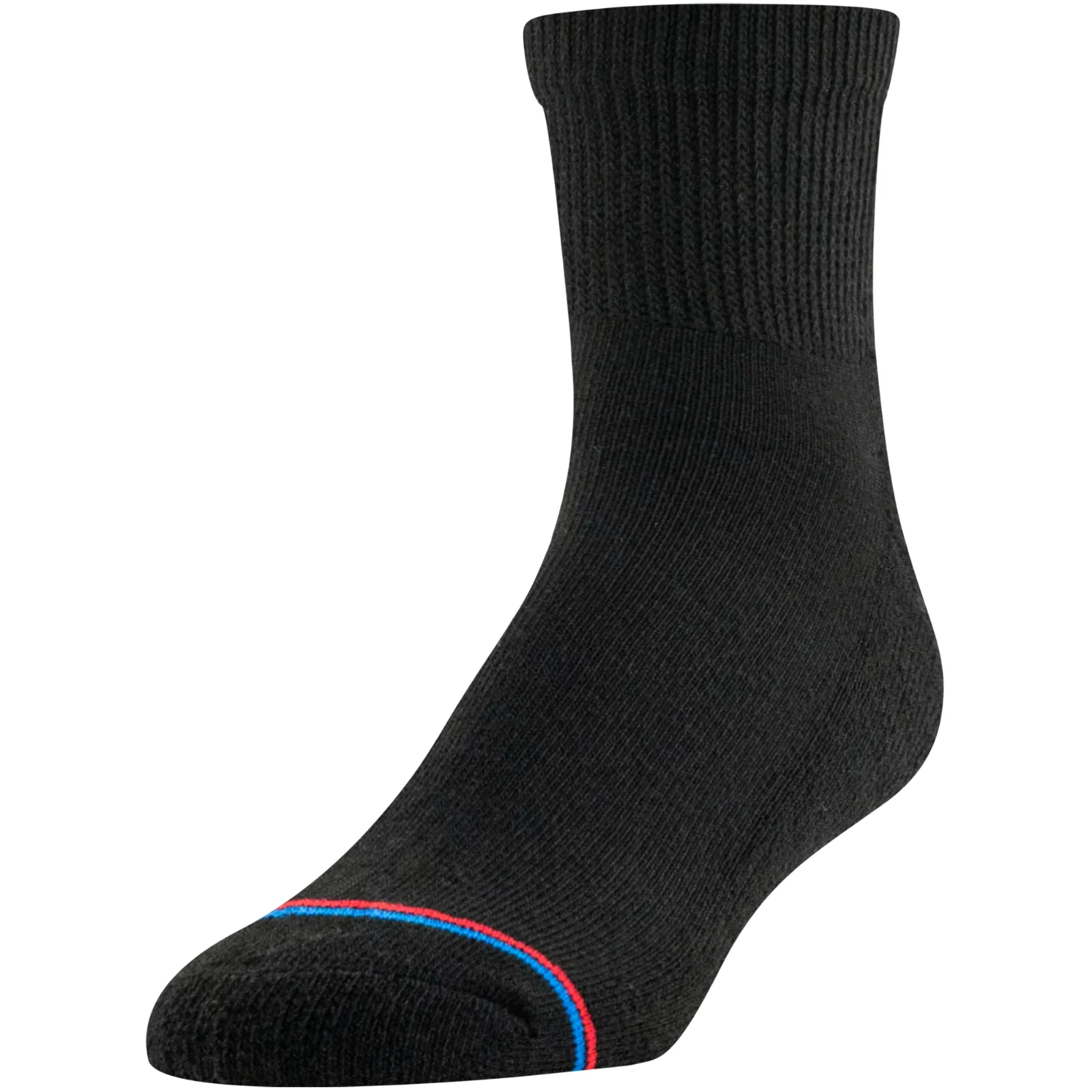
The mark above the ankle
You will notice it first as a thin ring of impression after a long day on your feet. The ring sits above the ankle where an ordinary cuff presses into the skin. Where that band appears depends on how high you wear the sock, and how snug your calf is. Your skin records the pressure because an ordinary sock cuff contains a rubber thread knitted through it. That thread holds the sock up during activity and, by evening, it is the same thread that presses a ring into the skin above the ankle. The sensation varies. Some people feel only a shallow line. Others feel tenderness where circulation is not the issue, but the pressure is. If you examine the cuff you will see the thread as a slightly firmer row within the knit. Take the thread out and two things change at once. The first is the mark: with nothing pulling the yarn into a ring, there is nothing to press one. Expect fewer marks where material closed tightly before. Expect other behaviours in fit. Your calf shape matters. On a smooth, tapered calf a cuff that does not grip can slide. On a more textured calf the same top may rest all day. The trade-offs tie back to a simple mechanism: a rubber thread pulls the yarn into a ring. Remove that thread and the ring is gone. You gain comfort for the skin surface. You give up the hold that ring provided.
What is inside an ordinary cuff
You can read a cuff by touch. Run a finger along the top edge and you will feel a tighter course of knitting. That tighter course is the rubber thread knitted through the cuff to hold the sock on the leg. The rubber thread is thin but resistant. Over repeated wear it compresses the skin where it sits. The consequence is a ring of pressure that becomes visible at the end of a day. If you press gently you can feel the difference between the plain yarn and the row holding the cuff. Knitters place that thread deliberately because it performs a single job: prevent the sock from sliding. The job is mechanical. No other part of the sock produces the same narrow, inward force around the leg. An ordinary cuff is one structural element made of two things: yarn for the shape, rubber thread for the grip. The yarn gives the cuff shape. The rubber thread supplies the constrictive force. Together they reduce the chance that the sock will travel down. That combination is efficient for keeping the sock up. It is also the origin of the impression your skin records. The presence or absence of that thread explains why two socks that look similar on the shelf behave differently on the leg. You can inspect a cuff and decide which mechanism you prefer. If you need a cuff that grips, look for the telltale firmer row. If you prefer no ring, choose a different knit.
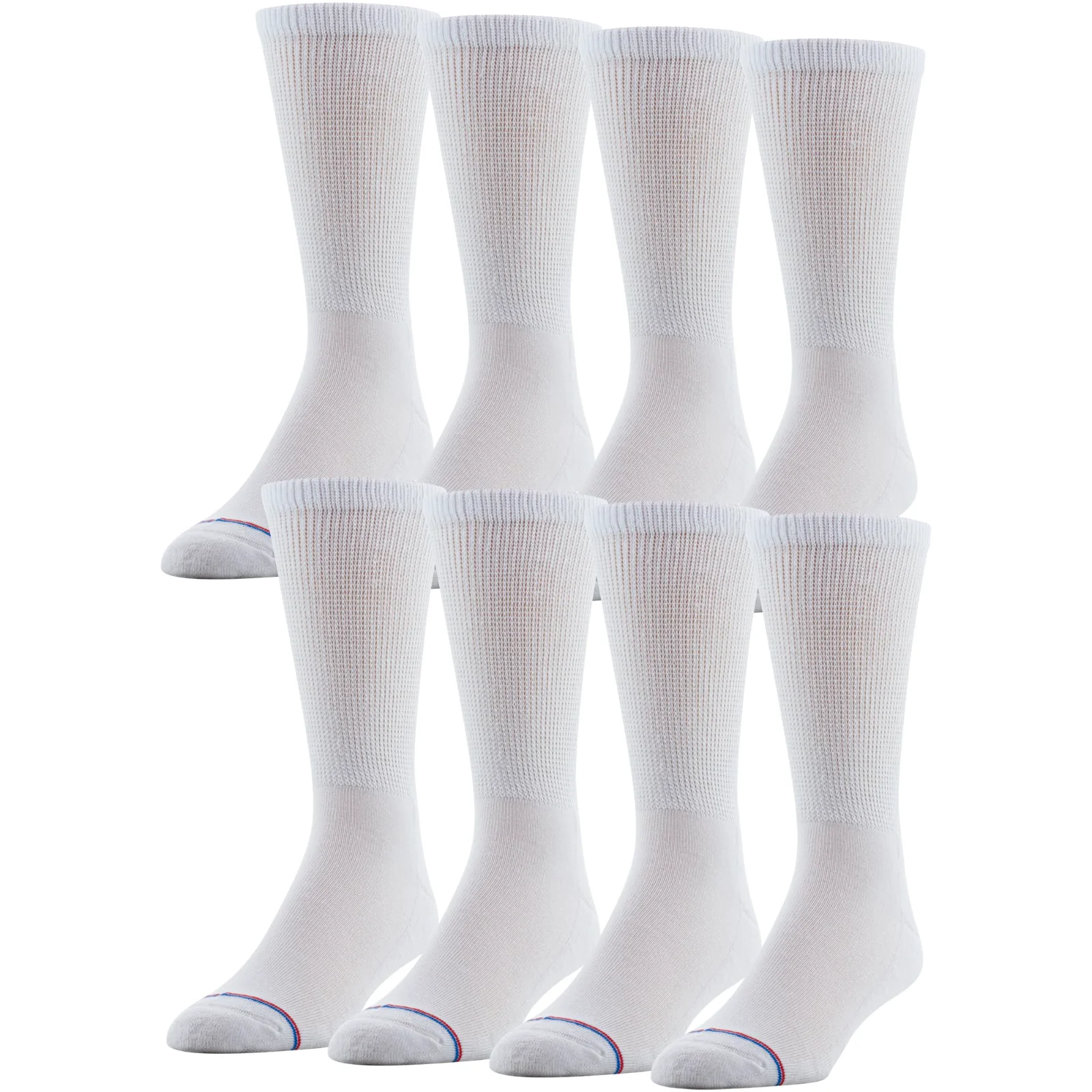
MediPeds Non-binding crew socks with cushion, 4 shoe sizes
4 or 8 pairs a pack · Cushioned sole · 4 shoe sizes
$11.26
Knitting a top that rests instead of gripping
You will notice the difference when you slip the sock on. A non-binding top is knitted from the same yarn as the leg, with extra stretch worked into the top, and no rubber thread. The knit does not constrict the calf. Instead it rests on it. The result is a band that closes softly without pinching. Stretch is added during knitting so the fabric can widen and return without forming a tight ring. The technique is simple in concept. The same yarn that forms the leg continues up through the top, but the stitch pattern and tension change to give more give. Your calf receives a gentler contact. There is no single point of inward pressure. You will not get the raised ring where a rubber thread used to be. That absence is intentional. It addresses the visible and tactile signs that some people want to avoid. The trade is immediate and obvious. Without the rubber thread the sock relies on other features to remain in place. Fit along the foot, the friction of the shoe, and any extra padding underfoot become more important. If you have a smooth calf, you might find the top can slide. If your shoe interior provides friction, the sock will stay. Your routine decides this more than the label does. A resting top suits people who prioritise reduced surface pressure. It changes how the sock behaves with footwear and movement.
The trade: a cuff that can slide
You will find that the trade-off is real and measurable. A cuff that does not grip can slide, and on a smooth calf it sometimes does. Sliding is not a mystery. Without the rubber thread the knit offers no concentrated inward force to stop downward motion. Motion, gravity, and the shape of your leg combine to move the sock. The frequency of that movement depends on how you walk, the fit of your shoe, and the texture of your calf. In practice a sock that rests works best when other elements help keep it in place. One helpful element is friction inside the shoe. Another is padding under the foot. The cushioned sole adds loops underfoot and around the heel, which pads the foot and increases friction against the shoe interior. That friction can hold a non-gripping sock still. Conversely, on a slippery shoe lining or on smooth skin, the resting top has less to resist sliding. A wider cuff compounds the issue because it has less to hold on to and slides more readily than a standard one. An extra wide top gains knit bulk around the leg but loses holding power. You will judge whether the gain in comfort is worth the occasional adjustment. If sliding causes blisters or rubs, that is a clinical question and should be discussed with a clinician. For everyday wear, many people accept a slight tendency to slide when they value the absence of a pressure ring.
Why the cushioned sole is part of the answer
You should consider the sole when you think about a non-binding top. The cushioned sole is extra loops knitted into the underfoot and around the heel. Those loops add padding to the foot. The padding reduces the transmission of shoe friction to the skin. That is one effect. The other is that a padded underfoot increases friction between the sock and the inside of the shoe. Increased friction holds a non-gripping sock still. The grey yarn used on two-tone socks is the cushioned yarn. It shows exactly where the padding runs and stops where it stops. You can see the boundary of extra loops by the change in colour. Where the padding covers the heel and the underfoot, you gain both a softer feel and a stabilising grip. The mechanism is mechanical, not medical. The loops catch slightly on the shoe interior and resist movement. Your choice of shoe matters. A snug shoe with a rougher lining will work with the cushioned sole to keep a resting cuff up. A loose shoe or a slick lining will not provide the same restraint. The toe seam on these socks is knitted flat rather than folded and stitched. That creates no ridge across the top of the toes, which reduces friction points inside the shoe. Taken together these elements adjust how freely the sock moves. You will decide the balance between surface comfort at the calf and the need to keep the sock from descending.
Where the wide top is a different problem
You will encounter a distinct behaviour with an extra wide cuff. The extra wide sock is knitted with more yarn around the cuff and more give in it. The foot of the sock stays the standard width for its shoe size. Ordering a bigger size buys length, and length is not what the calf is short of. That means the extra width of the cuff does not translate into a broader foot. The wider cuff has less to hold on to and slides more readily than a standard one. The effect is mechanical. Where a standard cuff relies on a modest inward force across a narrower face, a wide cuff spreads any holding force across more surface area. Spread the force and the per-millimetre grip falls. You will notice more movement if your leg tapers or if your shoe fit is loose enough to permit slippage. A boot collar interacts with these choices. A boot collar lands almost exactly where a quarter sock ends and will push it down. Wearing a quarter sock with a boot collar therefore risks the sock being displaced during use. A crew that reaches mid-calf may avoid the collar contact. An over-the-calf sock finishes just under the knee and therefore is not subject to the same collar interaction. Your selection should consider where footwear contacts the sock. A wider cuff offers a gentler surface for the skin. It also increases the chance you will need to adjust the sock during the day.
What the guidance says, and what it does not
You will find clear pointers from health authorities about sock choice. The National Institute of Diabetes and Digestive and Kidney Diseases advises choosing clean, lightly padded socks that fit well. It adds that socks with no seams are best and that people should not wear tight socks or elastic stockings. That guidance aligns with the construction of a non-binding top paired with a cushioned sole and a flat toe seam. The seam across the toes on these socks is knitted flat rather than folded and stitched, so there is no ridge across the top of the toes. Where the guidance is specific it speaks to fitting and padding, not to how a particular cuff design will behave with every body. The guidance does not prescribe sock heights or knitting techniques. It does not comment on the sliding tendency of a cuff that rests. If you have questions about wounds, circulation, or other clinical matters, consult a clinician. We can report what the sock does, not what it treats. Care instructions for these socks are explicit. Machine wash cold with like colours. Use non-chlorine bleach only when needed. Do not use silicone-based softener, which includes fabric softener and dryer sheets. Tumble dry low and do not iron. Packet sizes in this range are two, three, four, six and eight pairs. Those practical details are what separate one model from another once a routine is specific.
| Name | Roughly where it stops on the leg | What it suits | What it does badly |
|---|---|---|---|
| Crew | Stops around mid-calf | Suits mid-calf coverage | Noted fact only; may contact a boot collar in some shoe types |
| Quarter | Stops about two fingers above the ankle bone | Suits low crew coverage and everyday wear | A boot collar lands almost exactly where a quarter ends and will push it down |
| Sport-cut liner | Finishes below the shoe line | Suits use where little visible sock is wanted | Offers little leg coverage; may be under the boot collar line |
| Over-the-calf compression sock | Finishes just under the knee | Suits high-leg coverage | No facts listed here about negatives for compression; it simply finishes under the knee |
Three more pieces like this one sit in the foot-care notes, the MediPeds desk keeps every height and pack count one click away on the front page, and the bodies behind every statement about a foot are listed on how we update the catalogue.
Every pack count, every shoe size
Every packet in the MediPeds lineup sits behind this button, with the price from our last update against each one.